Week of February 27
February 26, 1876 – 150 YEARS AGO
Rockland County Journal
THE OLD FOLKS’ CONCERT, &C.
Washington’s Birthday, on Tuesday last, was observed in Nyack as it has never been observed among us before. Bunting was displayed from very many buildings, and with our banks and some few stores, it was kept as a public holiday. Association Hall was handsomely decorated with a large variety of flags and other decorations, many of them the gift of our fellow citizen, John I. Salisbury.
At an early hour in the day, the tables for the Centennial Tea Party were spread with almost every delicacy that heart could wish, or appetite crave, and at two o’clock the old ladies, some of whom were dressed in the linsey-woolsey of one hundred years ago, began to assemble and engage their energies on a magnificent centennial quilt pieced by the ladies of the committee.
The room soon presented a most animating appearance, many of the young ladies being dressed in some of the most ridiculous costumes imaginable, while others looked simply charming.
As the hour for the commencement of the Old Folks’ Concert approached, the large hall began to fill up so that standing room in a short time was scarcely attainable. Knowing that the singing could not be enjoyed under such circumstances, and many being timid in relation to the great weight on the floor, it was finally determined to adjourn to Smithsonian Hall and there hold the concert. On this announcement being made by Mr. J. H. Blauvelt, president of the Association, the vast crowd soon found its way to the above-named hall which was immediately filled to its utmost capacity.
The choir, consisting of forty singers, each one of whom was dressed in costume which might have been fabricated in the fourteenth century, was under the direction of G. D. Wilson, and considering that they had but two short rehearsals in which to practice together, they did admirably. The pieces selected were such as were popular fifty or sixty years ago, and as we listened to the melodies we felt that while we had advanced, perhaps, in the science of music, the advancement had been made at the expense of many things which modern notions and innovations had put out of sight.— The singing, all things considered, was excellent and the approbation of the audience was testified at the conclusion of every piece. Henry W. Sherwood, our accomplished school principal, read admirably a poetic address to John Bull in which he was twitted in relation to the many blue days experienced by his armies in the revolution. Mr. Jerry Martine personated very cleverly a Hessian soldier of the revolution, and in fact the entire entertainment yielded the greatest enjoyment. Towards the conclusion the Centennial quilt was put up at auction and finally knocked down to D. J. Blauvelt for the sum of fifteen dollars. After this Rev. Henry V. Voorhees proposed a vote of thanks to the ladies and gentlemen who took part, and the same was given with a heartiness pleasant to witness. After the concert, a very large number—in fact nearly all—repaired to Association Hall again and made an onslaught on the eatables which were left. We are gratified to be able to state that this entertainment was not only the best ever given in our village, but that the benefit to the Association was also the best, having netted over all expenses about $187.
February 27, 1926 – 100 YEARS AGO
Rockland County Times
PIERMONT HIGH SCHOOL DAMAGED BY FIRE
The main building of the Tappan Zee High School in Piermont was badly damaged by fire on Thursday of last week. The interior of five rooms in the school was gutted by the flames and the damage is estimated at $20,000.
Highland Hose Company and Chelsea Hook and Ladder Company responded to the call sent to Nyack for extra help when it was found that the Sparkill and Piermont Departments could not cope with the situation.
While the fire was still in progress, the Board of Education held a special meeting and made arrangements for the 350 pupils of the school so that there would be no delay as a result of the blaze. The next morning promptly at nine o’clock, Principal Stiteler assigned some pupils to the Sparkill School, some to the gymnasium of the new Piermont building and some to the Sunday school rooms of the Catholic Church which had been immediately offered for use as classrooms. Seven rooms of the main building were quickly made ready for use so that classes could assemble in them on Tuesday of this week. The other grades will be accommodated in the outside quarters until sufficient repairs have been made.
The fire was entirely lacking in spectacular features and a hole in the roof is the only evidence that there has been a fire. The cause is still unknown.
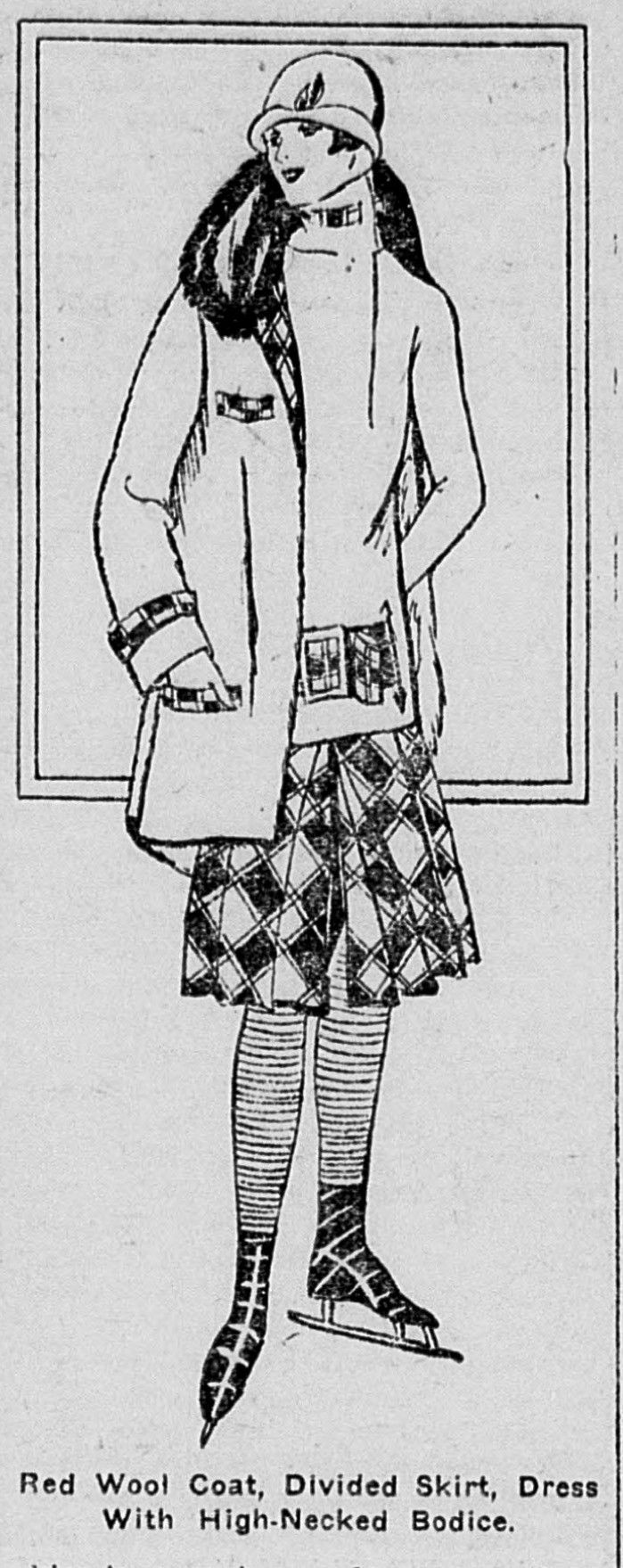
OUTFITS SUITABLE FOR SPORTS WEAR — Jacket, Skirt and Knickers, Coat, Sweater, Important Garments
[Image: Red wool coat, divided skirt, dress with high-necked bodice. Clipped from Rockland County Times, February 27, 1927.]
Whether you skate or ski this winter, or if you do both, the identical outfit will suffice, says a fashion writer in the New York Herald-Tribune. Several types share the smart spotlight. There is the outfit consisting of jacket, skirt and knickers, the costume comprising coat and knickers and an ensemble of coat, skirt, sweater, and knickers. The question of greatest moment in whether or not to include a skirt, and we should answer it differently, according to the degree of youth of the wearer, remembering, of course, that for skiing the skirt is always dispensed with. For skating. the very young and the slender post-debutantes may omit the skirt—they do not have to—but the matron looks a bit forced in knickers alone, and for her the skirt is a graceful essential. If you want to vary the costume carry your skirt in your bag and wear it whenever occasion or variety demands.
You might omit it when indulging in the active sport and slip it on when going into the clubhouse for tea. Snowshoeing, which is enjoying a suddenly revived popularity, requires the same type of costume as skating except that the skirt is preferably omitted.
Skating demands the fewest clothes compatible with comfort, snowshoeing requires a little more, while skiing and tobogganing demand more and heavier wraps. For these latter, a suede jacket and a fleece wool coat are prescribed, although a smart substitute for the former is the short washable leather jacket in gay colorings.
The ensemble note retains its vogue for all winter sports occasions the smartest matching outfits are developed in brightly colored woolens, notably orange, yellow, scarlet, green, and rose. A chic costume consists of jacket, sweater, skirt, knickers, scarf, and hat, all made of a bright orange wool and each having a contrasted jacquard border.
February 25, 1976 – 50 YEARS AGO
Our Town
HUDSON FISHING GOES FROM FEAST TO FAMINE
For years, Dink Hardy of Piermont has wrested a precarious living from the Hudson River. Like the dwindling number of his fellow commercial fishermen. Hardy has watched the river turn into a cess pool of pollution, then, all too slowly, become cleaner.
Last year, Hardy became famous when he caught a huge 198 lb, sturgeon—the largest ever to be netted in the Hudson. This year, he doesn’t know if he will be able to fish the river at all.
With stripped [sic] bass season rapidly approaching the river remains closed to commercial fishing by order of Ogden Reid, the state’s environmental commissioner.
Reid imposed the ban after traces of PCB, a toxic chemical used in the manufacture of electronic capacitors and transformers, were found in river fish. The PCB was discharged from General Electric plants upriver at Ford Edwards and Hudson Falls.
On Monday, Hardy attended a meeting of commercial fishermen at Poughkeepsie. He and the others came away confused.
“We still don’t know what Mr. Reid has in mind,” Hardy told Our Town. “He didn’t ban shad fishing, and shad season starts March 15. But what do we do with the [striped] bass and the other fish that we catch in our shad nets? Reid hasn’t given us any answers to that question.”
Hardy could start catching shad on March 15—but because of the ban on [striped] bass, “It doesn’t even pay me to put my nets out,” he said. “I might as well wait until April when more shad are running.”
For Hardy and the other fishermen, loss of the [striped] bass will put a severe crimp in their income. Half their yearly catch is the shad, which swim up the Hudson from the ocean to spawn. But the other half is [striped] bass, carp, eels, and perch, all of which [are] on the banned list.
“What are we supposed to do with that much contaminated fish?” asks Hardy. “I think the best place would be Mr. Reid’s backyard.”
While Hardy is worried about loss of this year’s crop of fish, he is also concerned about future fishing. So far, Reid has given no indication when the ban might be lifted.
“He says the chemical has settled to the bottom of the river and might remain indefinitely,” Hardy says. “Where does that leave us?” And Hardy is also anxious that Reid pursue General Electric with the same vigor with which he imposed the fishing ban.
“It’s easy to determine Mr. Reid’s one-sided viewpoint,” Hardy says. “After all, what’s a few million dollars and a handful of commercial fishermen compared to one of the biggest, multi-million-dollar enterprises like GE? We can’t afford to lose their good tax money, so we might as well ban the commercial fishermen.
DISPUTES CONCLUSION
Hardy disputes Reid’s conclusion that [striped] bass and other river fish are contaminated with traces of PCB. The federal environmental agencies, he says, have found no conclusive evidence that harmful amounts of the chemical are in the fish.
“The federal agencies didn’t find enough of an accumulation to ban fishing, or the eating of fish,” Hardy says. “So how can Reid impose a ban when his evidence isn’t as conclusive as the federal government’s?”
And he’s also angry because only commercial fishing—not sport fishing—was banned. “What’s to stop some angler from catching a few hundred lbs. of [striped] bass and taking them to the market to sell?” he asks.
So far, Hardy and the others have only been able to ask questions. No one has received any answers. But there isn’t much time left if the Hudson is to remain a commercial fishing river. In 1950, 369 fishermen applied for shad licenses. By 1973, that number had dropped to 40.
This Week in Rockland (#FBF Flashback Friday) is prepared by Clare Sheridan for the Historical Society of Rockland County. © 2026 by The Historical Society of Rockland County. #FBF Flashback Friday may be reprinted only with written permission from the HSRC. To learn about the HSRC’s mission, upcoming events or programs, visit www.RocklandHistory.org or call (845) 634-9629.