Week of January 9
January 8, 1876 – 190 YEARS AGO
Rockland County Journal
PALISADES
To the Editor of the Journal
Now that the centennial year of our independence has come, and we have reached that point in the history of our country in which we can celebrate its one hundredth year of civil and religious liberty, with the proud assurance that there is not a nation that can excel us in these two points. And when we take in to consideration the great progress that we have made, in the arts and sciences, in the short space of one century as, compared with other nations, this is certainly a feature in the history of our country that we ought to be proud of, and demonstrate it with more than an ordinary zeal. In honor of this event the people of our village have not been wanting, for the year 1875 had not run its race, when they began to fire a national salute and the bell in our church rang in the year 1876 for the first time. The cannon used on this occasion was one of the old revolutionary pieces, and is reported to be one hundred and five years old.
It was the property of the late Hon. Lawrence Sneden, and has been in possession of the family for half a century. There has never been in this place a celebration or patriotic outburst that will be remembered or praised more than the one that took place on the ushering in of the year 1876.
—W. E. G.
January 9, 1926 – 100 YEARS AGO
Rockland County Times
NEW INDUSTRY COMING — Simon Family Rents Second Floor of Factory Building to Large Needle Work Firm
The display advertisement in another part of this paper by which the firm is looking for operators of various classes of needle work is a verification of the article published in the Times two weeks ago about the visit of a representative of the big Marcus manufacturing firm which makes a specialty of women’s dresses, aprons, blouses and other kindred lines of work including many holiday novelties and discloses that the firm has closed negotiations with the Messrs. Simon for the leasing of the second floor in the new factory building at West Broad Street and Maple Ave. Not only have the negotiations for the lease of manufacturing space, but the process of assembling a plant is already in operation, some of the machinery including the electrical operating devices has already reached Haverstraw and is being put in position by a small army of mechanics.
This will be pleasing news to the workers of Haverstraw in that it indicates an additional manufacturing enterprise of considerable proportions and is a demonstration of the tore-sight and financial ability of the Messrs. Simon in constructing this great necessary building for the helpful development and prosperity of the village.
IT MAKES US FEEL SAD
It makes us feel sad when we think that the ten-year-old who promenades on Broadway with a mammoth cigar in his mouth, has yet to be moulded into manhood with his mother’s slipper or the flat side of his father’s hand. It makes us feel sad when the young man who stands shivering at our church doors as the people pass out, fails to attract the attention of any except those who think he is a “fool.” It makes us feel sad as the young miss of fourteen winters passes by with all the airs of a belle of twenty, to hear some one remark: “Her mother ought to spank her and keep her off the street.” It makes us feel sad, as we see a crowd of men congregated in our village stores, to think that it should be the mission of those unfortunate men to have to stand in there and keep customers out. It makes us feel sad to think that the young man or lady who goes to the post-office regularly twice a day doesn’t receive or expect a letter more than once a year. There are a great many things in this world which make us feel sad.
January 8, 1976 – 50 YEARS AGO
The Journal News
GRIM MEMORY . . . LANDSLIDE
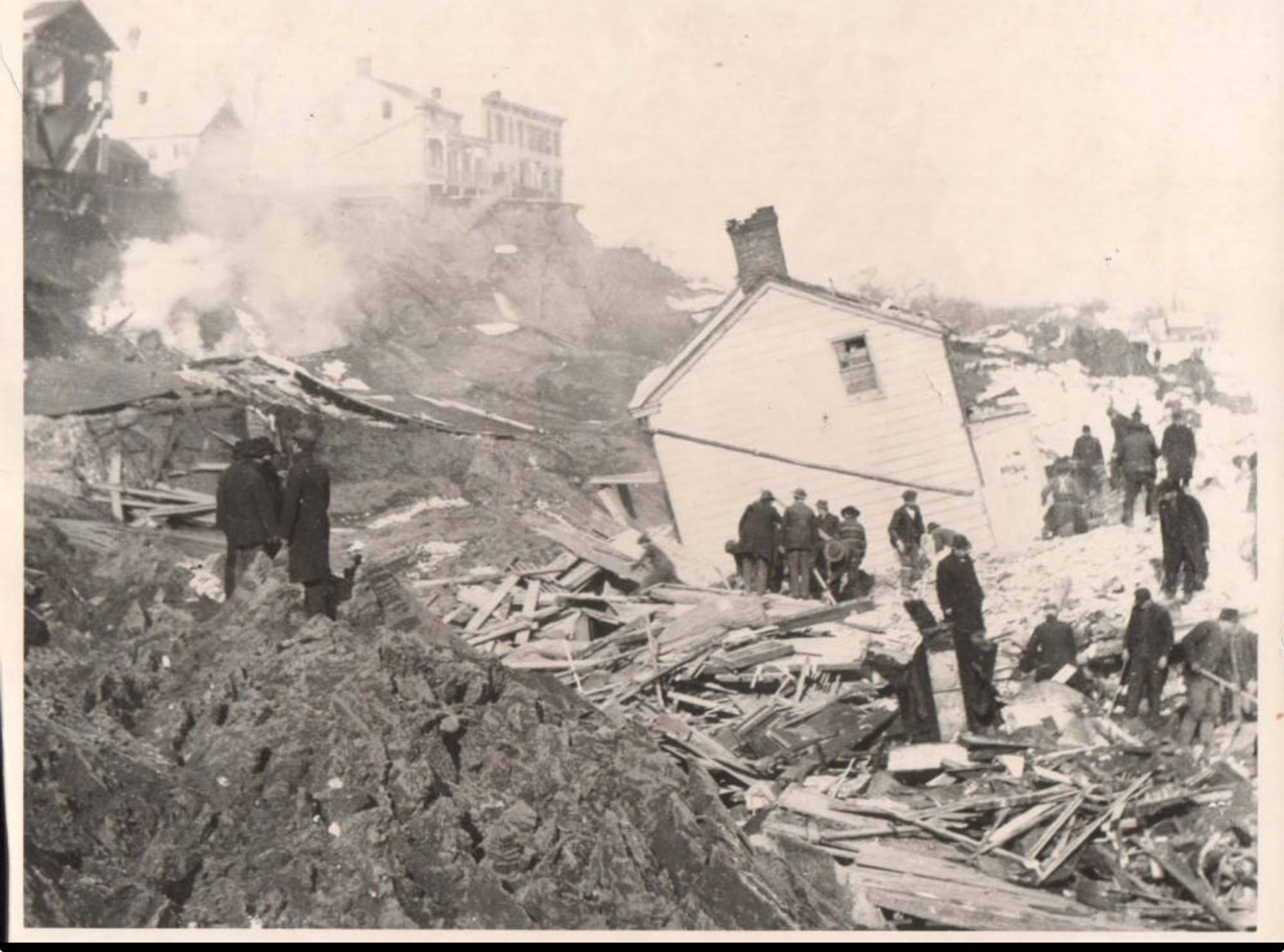
There was a plunge, a shivering of the earth and then there was stillness. It was the stillness of death for 19 Rockland residents killed in the county’s worst recorded disaster—the Haverstraw Landslide.
Today is the 70th anniversary of the tragic evening of Jan. 8, 1906, when homes, streets and entire families were swept into a man-made chasm and swallowed up by the brickyard clay-pits that were the economic foundation of the community.
For many the catastrophe was not unexpected. The village had tried to prevent brickmakers from undermining homes as they dug for the area’s fine clay.
When the disaster did come, it came swiftly and for many there was no escape.
It was a cold night and snow had fallen in the predominantly Jewish section of the village, according to Daniel DeNoyelles, Sr., of Thiells. This snowfall was to prove the salvation of many wood-frame homes before the night ended.
De Noyelles was only one year old at the time of the disaster; his interest in local history has led him to further investigation of the incident.
Some of the homes bordering the Eckerson-Gillies-Excelsior claypit had already been evacuated by families which heeded the warning signs—large fissures had opened in yards and roadways.
Others were in the process of moving families and possessions from the threatened houses, while many just ignored the warnings and went to bed. The first slide along the claypit’s south and west edges ripped the area at about 11 p.m.
“It came without an instant’s warning,” a Jan. 9, 1906, newspaper account of the disaster in the Nyack Evening Star said. “Those who lived in the houses at the end of the row which did not go down with the wreckage were awakened by a fearful roar and crash above which could be heard the shrieks of the victims.
Fourteen houses plummeted into the 100-foot-deep clay-pit as a large, semicircular section of the fine clay slid towards the quicksand-covered river area. Eight other homes remained precariously perched on the overhang left by the slide.
The crushed, partially buried homes in the clay-pit quickly caught fire as coal stoves and lamps ignited their splintered frames.
“The slide took out pieces of five or six streets in Haverstraw, creating semi-circle perhaps half a mile in length from Warren Avenue to Allison Avenue,” DeNoyelles said.
“We, the DeNoyelles family, rented a house on Allison Avenue and the slide stopped just short of our house.
“I was only about a year old when this thing happened, but it was still fresh in everyone’s mind when was a teenager,” he said. “Most of the lawsuits were not settled until 1912 or 1913 but no one got very much. Alot of local people lost relatives in the slide.”
In the moments following the slide, stunned neighbors sounded the alarm. Damage was widespread on Warren, Rockland, Clinton, Washington, Jefferson, Wayne, Allison, and Division streets.
It took little time for the flames from the wreckage to reach above the edge of the deep chasm. Men of the General Warren Emergency Company known as the “Old Dutch” joined with relatives and neighbors in fighting the fires and attempting rescue of the victims.
Garnerville’s SW Johnson fire company, the only local department equipped with a modern steam pumper, rushed to Haverstraw to aid the other volunteers. It was now shortly before midnight, less than an hour had passed since the land slide.
“As the crowds hurried to the scene and the fire department galloped up, a second landslide occurred,” the newspaper reported.
Several onlookers were swept over the side of the chasm to their deaths and a number of firemen lost their lives, according to DeNoyelles.
By 2 a.m. the clay pit was an inferno, and hundreds of rescue workers were unable to get close to the smashed homes in the pit according to the reports. Only one female victim of the pit land slide was rescued, although seriously injured when a burly brickyard worker lowered a companion to her aid with a rope.
The fires burned throughout the night and only the recent snowfall kept the flames from
spreading to the other wooden structures of the village and causing more widespread destruction, DeNoyelles said.
On Jan. 10. local newspapers reported that the search for the dead would be abandoned because of dangerous working conditions. Eight houses clung to a 250-foot-long strip of over hanging earth which threatened to fall on the workers below.
“To send a working party to dig for the bodies of the dead directly beneath the tottering mass would be nothing short of murder, and all work looking toward the recovery of the dead has been abandoned,” the newspaper said
This section of earth and houses was later dynamited by Army specialists from West Point who had responded to the tragedy, according to DeNoyelles.
In the following days the death toll was unclear, but 19 are now believed to have died. All but three of the bodies were recovered. Funeral services were held in the old opera house in the village.
Several thousand dollars in cash and supplies were quickly donated by Haverstraw residents and their neighbors in nearby villages, and safe shelter was provided for those who had lost their homes and possessions in the landslide.
There was a public outcry against those responsible, especially since smaller slides in previous years stood as warnings of what might happen, but no individuals were ever singled out.
Brick was selling for $10.50 per thousand the highest price since 1882, heyday of the Haverstraw industry.
“The owners of brick yards along the Hudson have veritable goldmines.” the Nyack Evening Star reported in an article adjacent to the announcement of funeral services for two of the landslide victims.
Today, remnants of the clay-pit can still be seen but most of the area is now covered by the lake created near the Hudson River by the Orange and Rockland Utilities. Inc., Bowline Point power plant.
The catastrophe which struck the tiny village is evident only in the visible edges of the ancient crater and the minds of some village residents who lost relatives and neighbors in the landslide.
A small cast-iron marker will be placed at the site in July as part of Haverstraw’s Bicentennial celebration, according to DeNoyelles.
This Week in Rockland (#FBF Flashback Friday) is prepared by Clare Sheridan for the Historical Society of Rockland County. © 2026 by The Historical Society of Rockland County. #FBF Flashback Friday may be reprinted only with written permission from the HSRC. To learn about the HSRC’s mission, upcoming events or programs, visit www.RocklandHistory.org or call (845) 634-9629.