Week of July 3
July 1, 1876 – 150 YEARS AGO
Rockland County Journal
THE CENTENNIAL AT PALISADES
The inhabitants of Palisades are proposing to celebrate the Fourth of July with appropriate ceremonies.
At eleven o’clock there will be exercises in the Methodist Church, among which will be the reading of the Declaration of Independence and some account of the early history of the southern portion of Rockland County, with a few short addresses, interspersed with the singing of National Odes.
A pleasant reunion is expected, and a cordial invitation is extended to all interested to attend the celebration.
AROUND HOME
☞ There will be a grand Celebration and Ice Cream Festival at Johnsontown, this county, on the 4th, at the M. E. Church. The Declaration of Independence will be read, and addresses will be delivered by Alonzo Wheeler, Irving Brown, and Rev. A. S. Freeman.
☞ A wagon-load of drunken loafers, from somewhere back of “sundown,” came into our village late on Wednesday night and disturbed the slumbers of our citizens by their ribald songs, howls, etc. They stopped at a saloon on Main Street, where they imbibed freely of “leg-weakener,” and then went on.
July 2, 1926 – 100 YEARS AGO
Pearl River News
THIS 4TH MARKS 150TH YEAR OF INDEPENDENCE
The Fourth day of July, this year of Our Lord, 1926, has an added significance, for it closes a century and a half of prosperous independence and national autonomy. On that eventful day, 150 years since, our valiant pioneers boldly signed their names to that scroll that defied the powers of the world and has stood the test of many wars and attempts upon our freedom.
In Philadelphia, on this 4th, there will be numberless pilgrims from all parts of the United States and of the globe to take part in and witness the magnificent celebration that will be staged there under the auspices of the Sesqui-Centennial International Exposition to fittingly commemorate this day in our history little boy was picked up in Pearl River Wednesday night at about 11 o’clock. He was questioned and it was found that he came from Letchworth Village. The little fellow was barefooted and hungry. While authorities were waiting for someone from the home to come for him, Mr. Theise of Central Avenue asked permission to take the boy for something to eat.
July 2, 1976 – 50 YEARS AGO
The Journal News
ROCKLAND COUNTY — 1776–1976 — STRATEGIC LINK — CENTER OF THE REVOLUTION
By Richard Wolf, Journal News Staff Writer
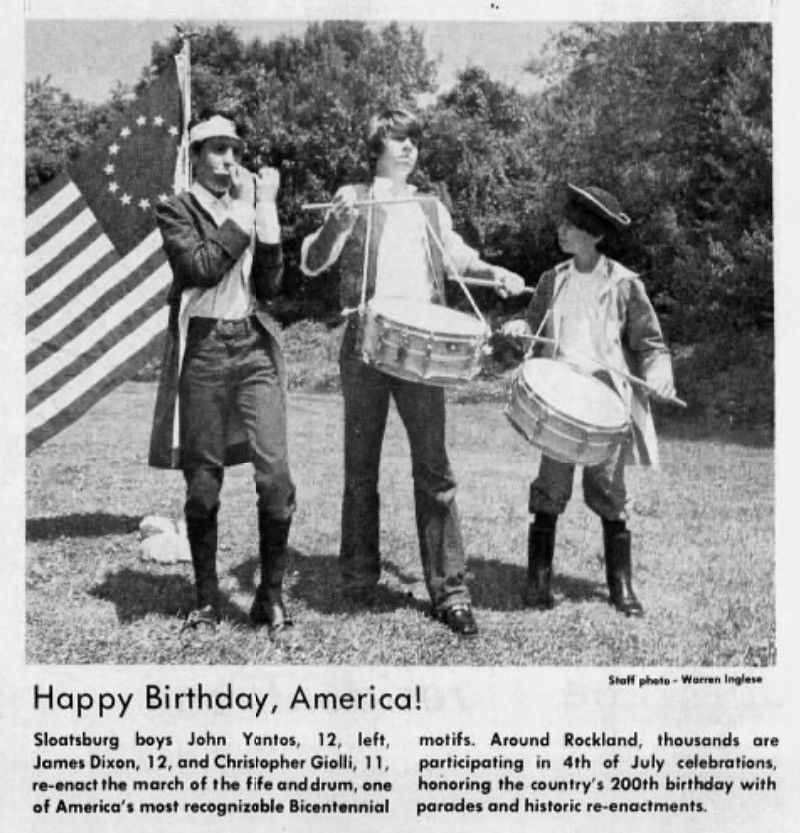
[Image: Happy Birthday, America! Sloatsburg boys John Yantos, 12, left, James Dixon, 12, and Christopher Giolli, 11, participating in 4th of July celebrations, reenact the march of the fife and drum, one of America’s most recognizable Bicentennial motifs. Around Rockland, thousands are honoring the country’s 200th birthday with parades and historic reenactments. Photo by Warren Inglese.]
The geographic area now referred to as Rockland County was at the center of activity during the entire length of the American Revolution.
From the signing of the Orangetown Resolutions in 1774 to the firing of two 17-gun salutes by the British in 1783, what is now New York state’s smallest county played a large role in the battle for independence from foreign domination.
Like most localities throughout the fledgling colonies, the triangle stretching from Palisades to Sloatsburg to Stony Point was greatly transformed during the war. Today, 200 years later, numerous historic sites are commemorated for future generations to recall their forefathers’ past.
In 1775 what is now modern-day Rockland was actually part of a vast territory known as Orange County. It stretched from the New Jersey border north to Murders Creek in Ulster County, and from the Hudson River west to the Delaware River near Port Jervis.
Rocky hills, gently sloping farmland, streams, swamps, and dirt roads carved from old Indian trails made up the area now known as Rockland County.
About 14,000 settlers inhabited Orange County in 1775, with about half that number residing south of the Ramapo mountains in the area which officially became Rockland in 1798.
There were four towns—called precincts—in Orange County, all of which were created in 1764. Two of them, Goshen and New Cornwall, were located north and west of the present-day Rockland boundaries.
Haverstraw covered what is now northwest Haverstraw covered what is now the northwest half of the county, including Stony Point, Haverstraw, Ramapo, and part of Clarkstown, Orangetown filled the remaining southeast corner of Orange County.
Tappan Village and the surrounding area was the most populated vicinity. First settled in 1641 The village was the county seat until 1774 when the courthouse and jail were burned to the ground.
Most villages sprung up at river landings and crossroads of travel. Other settlements south of the mountains included Suffern, Blauvelt, Nyack, Haverstraw, and New Hempstead.
Two major north-south roads provided the major routes of transportation in the county.
One extended from Tappan through Nyack to Haverstraw, while the other ran from Suffern through the Ramapo Pass to Albany. This road also branched in a northeast direction from Suffern, running near modern-day route 202 to Kings Ferry via Stony Point.
No direct east-west routes existed in the county during the Revolution.
Most of the early settlers were poor Dutchmen, but by the 1770s there were Irish, English, and French immigrants in the county. The settlers lived off the land, farming, fishing, hunting, and trapping.
Commerce focused on Hudson River traffic, and the only industries in the 1770s were several mines and iron works in the southwest corner of the county.
Daily living was similar to most other colonial areas in the 1700s. Social events and the education centered on churches, while political gossip was restricted to local taverns and inns.
With the levying of more taxes by Great Britain, the colonists began to resent the strict English rules and regulations, and gossip soon turned to talk of dissent.
In July 1774, the dissent came to a head when local patriots signed the Orangetown Resolutions, signifying one of the first official protests—however mild—against British action.
The protests snowballed thereafter as committees of correspondence were formed, representatives were elected to the Continental Congress, and Provincial Convention and militia was organized.
In October 1775 men from the area first began active participation in the war when the Continental Congress requested a contingent of Orange County residents to man the defenses along the Hudson Highlands.
As talk of war gripped the colonies, Orange County became divided on whether to support Britain or join the rebel cause.
Although the majority of residents sided with the struggle for freedom, the area still contained many loyalists, some of them merely opposed to the means which the rebels chose to seek their independence, but others wholeheartedly joined the Tory cause and actively fought against fellow colonists.
To the south of Orange, Bergen County, New Jersey was a hotbed of Tory activity, and several times loyalists led raiding parties to Orangetown to burn and pillage patriot farms.
The Ramapo Mountains also acted as a hideout for many Tory gangs who raided the suffering area during the war.
Opposing armies occupied the area many times during the 1770s and farmers found their fields foraged by both sides. A shift of loyalty and a constant district of neighbors accounted for the southern selections of the county becoming a neutral no man’s land during the war.
Rockland County was an important crossroads, a camping ground, a link to the northern colonies, and a scene of treason and conflict throughout the battle for independence.
The county was involved in the war right from the start, becoming embroiled in the great struggle for control of the Hudson River Valley.
Entire armies and vital supplies passed through Rockland on their way to war via two strategic links to New England and upstate New York, the ferries—Kings Ferry, north of Stony Point, and Dobbs Ferry and Palisades—provided passage across the Hudson.
Kings Ferry was used by General George Washington’s Continental Army many times, and in 1781 carried the French allies making their way to the final battle at Yorktown.
Dobbs Ferry, run by Tory Molly Sneeden, carried Martha Washington across the Hudson on her way to Massachusetts to visit her husband in 1775.
A second vital link in Rockland was the Ramapo Pass, which cut through the Ramapo Mountains at Suffern. It was the only north-south land passage located between the Hudson and Delaware rivers, allowing Washington’s forces mobility during the mid-Atlantic operations.
Rockland also served as a camping ground for the Continental Army during the mid-Atlantic campaign. Fields in Tappan, Pomona, and Suffern saw rows of pitched tents and fires of French American armies during the war.
When the British attempted to land at Nyack and Haverstraw in an effort to gain political, an effort to gain partial control of the Hudson River, they were repelled by local militia and forced to retreat.
The two major battles occurred at Stony Point and Bear Mountain.
Another major event that put Rockland in the history books was the treason plot of West Point Commander Benedict Arnold and the trial and execution of fellow conspirator Major John Andre in Tappan.
Rockland also was the site of the first formal recognition of the new nation by the British. This occurred in 1783 nine years after the signing of the Orangetown resolutions, when a British flagship fired a salute to America off Piermont, following the final meeting of General George Washington and the British military commander in Tappan.
After the war, county residents reverted to developing the area, rebuilding homes, and replowing fields ravaged during the successful fight for freedom.
This Week in Rockland (#FBF Flashback Friday) is prepared by Clare Sheridan for the Historical Society of Rockland County. © 2026 by The Historical Society of Rockland County. #FBF Flashback Friday may be reprinted only with written permission from the HSRC. To learn about the HSRC’s mission, upcoming events or programs, visit www.RocklandHistory.org or call (845) 634-9629.